I have recently been trialling the ZPacks Hexamid Solo. The Hexamid has been around for a few years now and has had various iterations through its life as Joe Valesko and the ZPacks team have worked upon the basic design and improved it.
I formerly owned a Hexamid a few years ago which was the version where the extended beak came standard but before the split beak of current models was introduced. I sold that model and actually regretted it later. The tent is super lightweight and, although it most definitely has limitations, it can find a useful place in any ultralight hiker’s gear list.
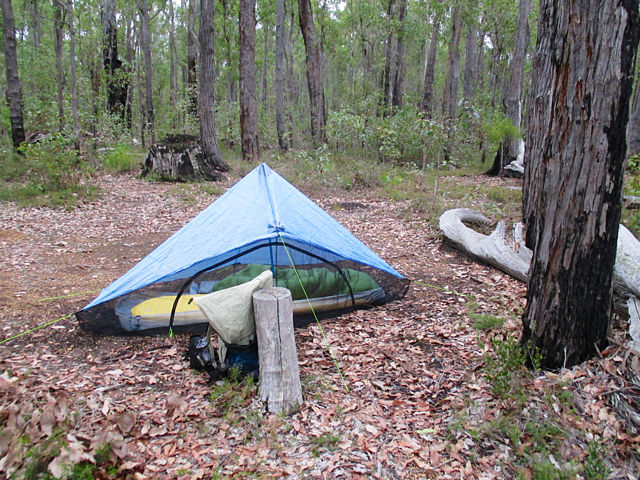
ZPacks Cuben Fibre 2013 in blue
The key specifications on the tent are 437 grams including the cuben bathtub floor but excluding stakes. This makes it one of the lightest tents on the market with the exception of super-minimalist shelters. So is this tent one worth considering? Read on to find out.
The tent is a single wall design made from 0.51oz/sqyd (17.4gm/sqm) cuben fibre. The geometry of the tent is a pyramid shape which has at its apex a reinforced section to take the top of a single trekking pole. The other end of the pole goes through a similarly reinforced section in the mesh floor. The tent has six main tie out points and two further tie out points which act to provide some additional strength in the rear of the tent across the rear cuben sheet as well as provide some additional living room by pulling the fabric away from the living area (albeit not by much).
The cuben material itself is very durable and strong. ZPacks believe it will last for at least one full 2,500+ mile thru hike in their view and I think this would be a fairly accurate reflection. The cuben will eventually soften with age and become more prone to damage. As long as the material is not subject to rough abrasion on a continual basis, it will serve the casual hiker for many years and I understand from the experience of others that it will be fine for a thru hike. The tent itself is supplied with cuben repair tape to make in the field repairs should they be necessary. The only repair I’ve had to make on a ZPacks tent was when the mesh developed a rip which was easily fixed with the repair tape on both front and back of the mesh surrounding the rip.
The material itself is fairly translucent. You can see through it from the outside but not so much it’s a privacy concern. The substantial mesh area at the front would be more so but this has never particularly been an issue or concern for me. The benefit of the material is that you often are able to see the stars from within the tent. The downside is the full moon which will feel like someone shining a bright light directly into your sleeping area.

Olive Green ZPacks Hexamid Solo 2016
The floor of the tent is probably the most controversial aspect of its design being all mesh. Many people have in the past expressed concern that the mesh floor will trap dirt, leaves and general mess. I haven’t found this to be the case even camping in wet conditions. The bigger concern is the durability of the mesh particularly around the zipper area. As previously mentioned this has already necessitated one repair. The key to this is being careful with the set up of the single trekking pole. If this is set up incorrectly, the mesh will be stretched and will be prone to tearing when the door is zipped close. Whilst this is a simple tent to set up, it does require some attention to correct geometry of set up and ensuring the tent apex is in the right position and you have the appropriate gap between the corners of the tent and the ground. Other than these little idiosyncrasies, it is a very quick tent to set up and is generally straightforward.

Hexamid Solo Interior and Mesh Screen

Side view of Hexamid Solo
The tent itself is fairly stormworthy and certainly no worse than the vast majority of three season tents. It will require a sheltered setup preferably out of the wind as much as possible. I think the design would be ok in light snow conditions but would struggle in driving snow due to the open interior. I have used the tent in a storm here in WA with 70kph wind gusts. The tent will stay up as long as it is staked well and you choose a suitable location.
It is important to recognise the limitations of this tent. It doesn’t block wind well. On the other hand, it means condensation is limited to a great extent. In addition, unless the bathtub floor is set up properly, I can see situations where any pooling water could be allowed to seep into the interior. In addition, as others have noted, situations with fine rain mist would not be good as this would tend to collect in the interior through the mesh front. The tent is also very small for a hiker such as myself who is 6’1″ or 1.87m. I know plenty have used this tent for a thru hike but it would be worth considering these limitations versus a tent such as the Duplex which avoids many of these issues due to its design.
This tent is quite expensive due to the materials involved but there is undoubted workmanship involved from the ZPacks team. The materials are costly but the tent is expertly constructed.
It is recommended for those truly trying to lower their base weight to the lowest amount possible.
 Hike Now